


Key Takeaways
- SIEM means Security Information and Event Management: a platform that collects, normalizes, correlates and analyzes security events.
- The core value is not storage alone. A SIEM turns logs into detection, investigation and compliance evidence.
- NIST SP 800-92 treats log management as an enterprise process covering infrastructure, operations and maintenance of logging practices.
- For NIS 2, a SIEM can support detection, incident handling, evidence retention and governance reporting.
- SIEM is different from EDR, SOAR and XDR, although modern tools often overlap.
- Open-source SIEM options such as Wazuh can be suitable for SMEs when design, tuning and operational ownership are clear.
Scope of This Article
This article defines SIEM, explains the typical architecture, compares adjacent security-tool categories and maps SIEM capabilities to NIS 2 and ACN baseline expectations. It is written for executives, IT teams and compliance stakeholders who need a practical buying and implementation frame.
What Is a SIEM
A SIEM is a security platform that collects security-relevant logs and events from systems, applications, identities, network devices and cloud services. It normalizes those events, correlates them with rules or analytics, and produces alerts, dashboards and reports.
The acronym stands for Security Information and Event Management. The information-management side covers collection, retention and search. The event-management side covers detection, correlation and escalation. Both matter: storing logs without investigation capability is archival; alerting without reliable log coverage is fragile.
NIST SP 800-92 describes computer security log management as a practical discipline for developing, implementing and maintaining effective log-management practices throughout an enterprise (NIST SP 800-92).
What Problem a SIEM Solves
A SIEM reduces the gap between events happening across the environment and people being able to detect, investigate and prove them. Without centralized log management, evidence is spread across servers, endpoints, firewalls, SaaS consoles and identity systems. That fragmentation creates slow investigation and weak auditability.
- Threat detection: identify suspicious sequences across multiple sources.
- Incident investigation: search events around an account, host, IP address or time window.
- Compliance evidence: show that monitoring and retention controls are operating.
- Operational visibility: understand failure patterns, privileged activity and anomalous access.
How a SIEM Works: Typical Architecture
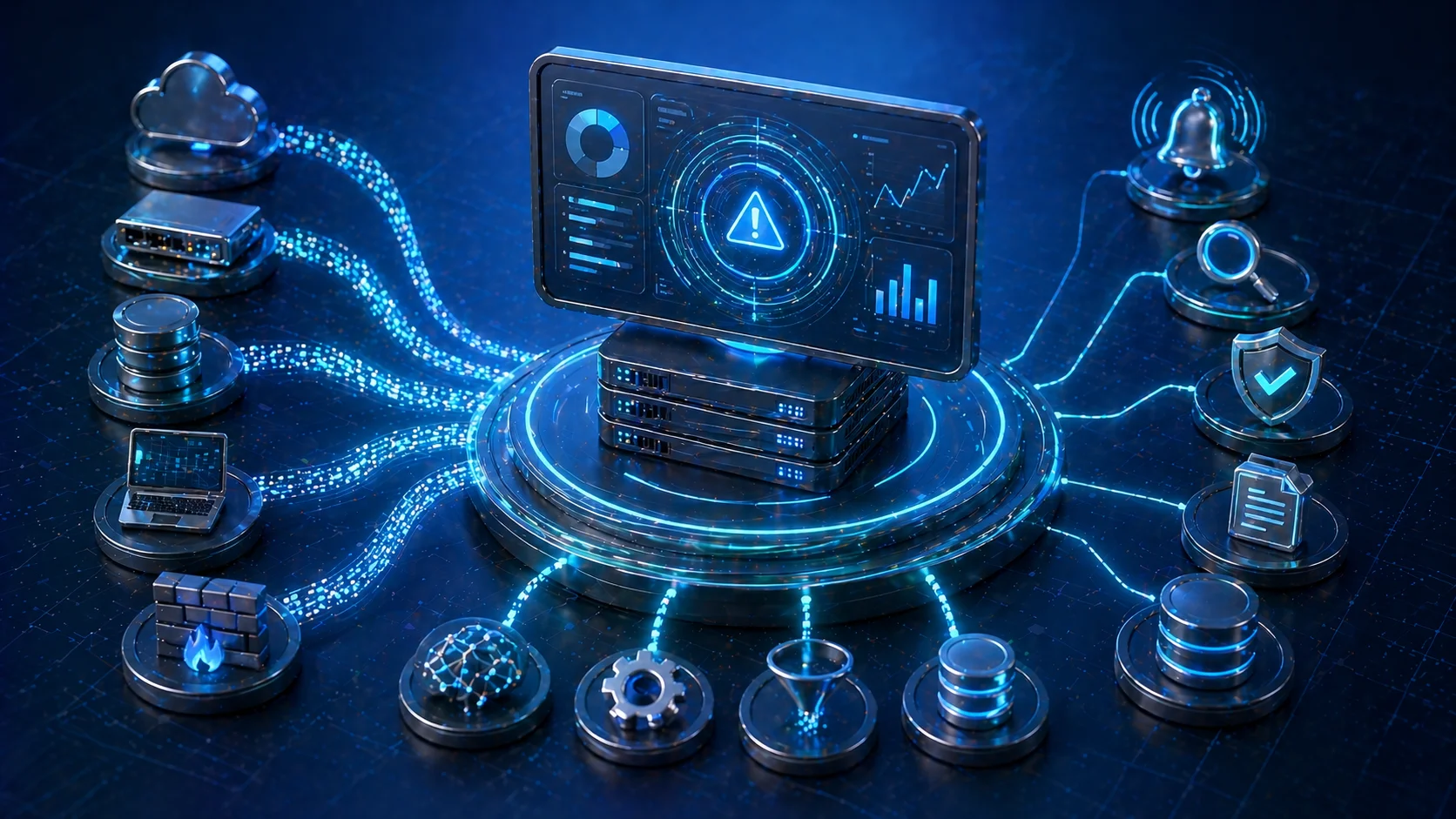
A practical SIEM architecture follows a repeatable flow:
- Sources: endpoints, servers, identity systems, firewalls, EDR, cloud workloads, SaaS platforms and business applications.
- Ingestion: agents, syslog, APIs, cloud connectors or collectors send events to the SIEM.
- Normalization: raw logs are transformed into consistent fields.
- Correlation: rules and analytics connect events that would be weak in isolation.
- Alerting: suspicious patterns generate alerts for triage.
- Investigation: analysts search, pivot and reconstruct timelines.
- Reporting: compliance and management reports show coverage and activity.
In a SME, the architecture should start with high-value sources: identity, firewall, endpoint protection, critical servers, cloud admin logs, backup systems and business-critical applications. Coverage can then expand by risk priority.
SIEM, Log Management, EDR, SOAR and XDR
| Tool | Primary role | Typical output | Difference from SIEM |
|---|---|---|---|
| Log management | Collect, store and search logs | Searchable evidence | May not include advanced correlation or alerting |
| SIEM | Correlate events and support detection | Alerts, dashboards, investigations | Central layer across many sources |
| EDR | Monitor and respond on endpoints | Endpoint telemetry and response actions | Deep endpoint view, not always full enterprise correlation |
| SOAR | Automate response workflows | Playbooks and case automation | Acts on alerts, often from SIEM or EDR |
| XDR | Correlate telemetry across selected security layers | Integrated detection and response | Often vendor-ecosystem driven |
Why a SIEM Matters for NIS 2 Compliance
NIS 2 and the Italian implementation framework emphasize risk management, incident handling and security monitoring. The Italian NIS decree implements the Directive's governance and incident-management obligations, while ACN baseline measures translate several expectations into more operational controls for Italian NIS subjects (Legislative Decree 138/2024, ACN baseline determination).
A SIEM does not make an organization compliant by itself. It supports specific evidence needs: log centralization, monitoring coverage, alert triage, incident timeline reconstruction and reporting. For more detail, see Aegister's articles on detection and event monitoring and operational registers, logs and backups.
Commercial SIEM vs Open-Source SIEM
Commercial SIEM products usually provide vendor support, packaged connectors, managed analytics and predictable procurement. Open-source SIEM options can reduce licensing constraints and improve transparency, but require stronger implementation discipline.
Wazuh is a common open-source option for file integrity monitoring, vulnerability detection, endpoint security, log analysis and compliance-oriented monitoring. Start with the Wazuh overview for NIS 2 compliance, then read the deployment guide, the centralized log-management article and the Wazuh vs commercial SIEM comparison.
When an Italian SME Needs a SIEM
A SME should consider SIEM adoption when at least one condition is true: it falls into the NIS 2 perimeter, handles regulated data, operates critical services, has recurring audit findings on logging, lacks incident evidence, or depends on fragmented cloud and endpoint environments.
The decision should include budget for log-source onboarding, retention design, rule tuning, alert ownership and incident workflow. A SIEM with no operator becomes shelfware; a smaller but operated deployment usually produces more value than a broad but unmanaged one.
What Is Needed to Implement a SIEM
- a source inventory and data-retention policy;
- clear ownership for log onboarding and parser quality;
- rules mapped to realistic threats and compliance evidence needs;
- triage playbooks and escalation thresholds;
- periodic review of noisy alerts and missed detections;
- management reporting that connects technical signals to business risk.
When a Managed Service Makes Sense
Many SMEs do not need to hire a full SOC team before adopting centralized detection. A managed approach can define the SIEM architecture, onboard priority sources, tune alerts and turn findings into a governance roadmap. Aegister supports this through Virtual CISO services and operational tracking in the Cyber Console.
Minimum Log Sources to Start With
A SIEM project should not start by ingesting every possible event. That creates cost, noise and operational fatigue. Start with the sources that explain identity, perimeter, critical systems and recovery capability.
| Source | Why it matters | Typical questions it answers |
|---|---|---|
| Identity provider | Most attacks involve credentials or privileged access | Who logged in, from where, with which privilege? |
| Firewall and VPN | Shows perimeter and remote-access activity | Which connections were allowed, denied or anomalous? |
| Endpoint protection | Connects alerts to hosts and users | Which device executed the suspicious activity? |
| Critical servers | Protects systems supporting core services | Which service changed, failed or generated access errors? |
| Cloud admin logs | Captures high-impact configuration and access events | Who changed policy, storage, keys or network exposure? |
| Backup platform | Supports ransomware readiness and recovery evidence | Were backups completed, tested and protected? |
Retention, Integrity and Evidence
For compliance, the retention policy is as important as alerting. The organization should define how long logs are kept, who can access them, how integrity is protected and how evidence is exported during an incident or audit.
NIS 2 and ACN-oriented evidence should show not only that a SIEM exists, but that logs from defined sources are received, searchable and retained according to a written policy. The evidence file should include source inventory, retention settings, alert-management records and examples of investigation timelines.
A Practical SIEM Roadmap
- Define the risk cases: ransomware, account takeover, privileged misuse, cloud misconfiguration and supplier access.
- Choose the first 5-10 log sources that prove those risk cases.
- Implement ingestion and verify parser quality before writing many rules.
- Start with a small rule set mapped to real response playbooks.
- Review alerts weekly for noise, false negatives and ownership.
- Report coverage and findings monthly to the risk or compliance owner.
Cost Drivers and Sizing
SIEM cost is not only license cost. The main drivers are event volume, number of sources, retention period, storage model, rule tuning, alert triage and reporting effort. Open-source software can reduce licensing costs, but it does not remove engineering and operational work.
For SMEs, the best sizing method is risk-based. Start with critical systems, identity, perimeter and cloud administration. Add lower-priority sources only when they produce actionable detection or required audit evidence. This keeps the SIEM useful instead of turning it into an expensive data lake.
Questions to Ask Before Buying or Deploying
- Which incidents do we need to detect first?
- Which log sources prove those incidents?
- Who owns alert triage during business hours and outside them?
- How long do we need to retain logs for audit and investigation?
- Which reports must go to management, compliance and customers?
- How will false positives be reviewed and reduced?
If these questions have no owner, the project should pause. A SIEM project is successful when it changes response capability, not when ingestion reaches a high event count.
FAQ
What is a SIEM in cybersecurity?
It is a platform that collects and correlates logs and security events to support detection, investigation and reporting.
Does NIS 2 require a SIEM?
NIS 2 does not prescribe a specific SIEM product, but the monitoring, incident-handling and evidence expectations often require SIEM-like capabilities.
Can Wazuh be used as a SIEM?
Yes, Wazuh can support SIEM and log-analysis use cases when deployed with proper architecture, source coverage and operational ownership.
What is the difference between SIEM and EDR?
EDR focuses on endpoints. SIEM centralizes and correlates events across endpoints, identity, cloud, networks and applications.